By Pierre Henry
We hear it all the time: electric vehicles are supposedly so heavy that they “eat through” tires much faster. The explanation seems logical. More weight means more load on the tires and, inevitably, more wear.
But is it really that simple?
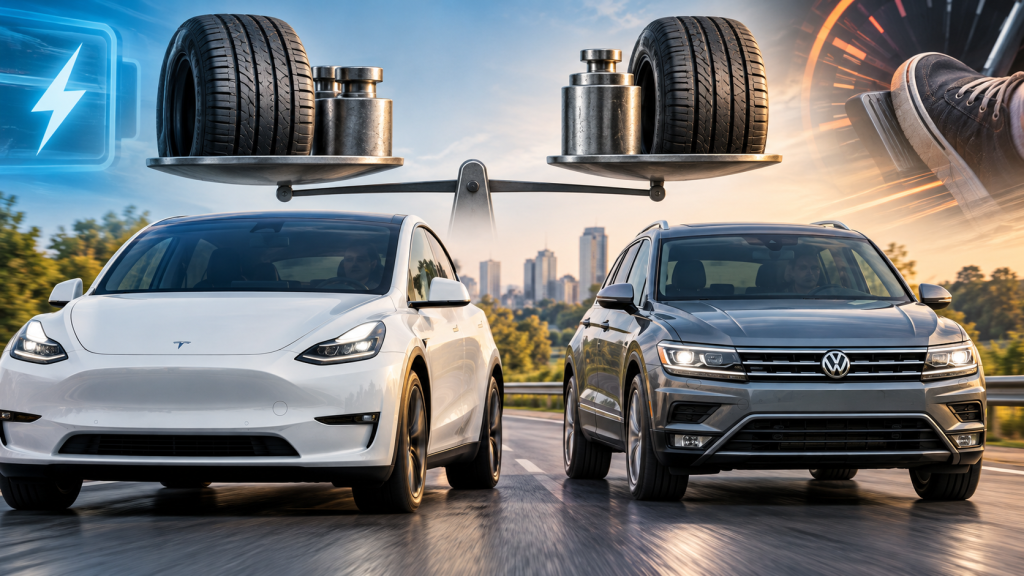
Let’s compare two 2023 SUVs: a Tesla Model Y AWD and a Volkswagen Tiguan 4MOTION. The Tesla weighs approximately 1,981 kg, compared with 1,736 kg for the Tiguan—a difference of 245 kg!
Now let’s look at how that weight is actually distributed.
The Model Y AWD has a nearly even weight distribution, with approximately 979 kg on the front axle and 1,002 kg on the rear. The Tiguan 4MOTION used in our comparison carries 983.5 kg on the front axle and 752.5 kg on the rear.
In other words, despite weighing 245 kg more overall, the Tesla actually carries about 4.5 kg less on its front axle than the Tiguan.
That certainly adds some nuance to the idea that EV tires wear out quickly simply because these vehicles are heavier.
What if your right foot also has something to do with it?
Of course, weight matters. But it is only one part of the equation.
An electric vehicle can deliver a significant amount of torque almost instantly. Hard acceleration and aggressive passing therefore put greater demands on the tires. And this is nothing new: a powerful vehicle driven aggressively has always had the potential to wear out its tires more quickly.
Tire pressure, wheel alignment, tire type, rotation and driving habits also affect tire life.
An important consideration in the shop
For shop managers, this may be where the real issue lies. When a customer comes in with an EV showing premature tire wear, “that’s normal, your vehicle is heavy” should not be the diagnosis.
What does the wear pattern look like? Is the tire pressure correct? Is the alignment within specifications? Have the tires been rotated as recommended? Are the installed tires properly suited to the vehicle? And how is the vehicle being driven?
These questions not only help identify the cause of the wear, but also allow the shop to provide better advice to the customer.
Weight matters, certainly. But before blaming the battery, let’s see what the tires are trying to tell us.
Picture credit : AI Generated